One team from business problem to running system.
MiniBytez takes responsibility for the whole of it: the process, the architecture, the engineering, the integration, the programme around it, and the system still being improved three years later.
Consulting ends where engineering begins, and nothing falls in between.
Four pillars under one programme. Each leads the stages it is best at, hands over deliberately, and stays accountable after it does.
Programme and project delivery
Governs every stage: scope, sequence, risk and change.
- Strategy
- Systems
- Engineering
- Integration
- Delivery
- Operations
Business systems consulting
Understands the operation and designs the systems it needs.
Leads Strategy to Systems.
010203040506Technology engineering
Builds the applications, APIs and data, and connects them.
Leads Systems to Integration.
010203040506Enterprise delivery
Proves, launches and runs the result.
Leads Integration to Operations.
010203040506
Runs through every stage
- Data
- AI
- Automation
- Integration
- Cloud
- Security
Six layers, engineered as one system.
Software built for how your business works, rather than a product you reshape your business around. Every layer is ours to build and ours to keep running.
Product experience
What customers and staff actually touch, on every screen they use.
- Web applications
- Mobile apps
- Customer portals
- Websites and landing pages
Applications
Software built around how the business works, not reshaped to fit a product.
- Enterprise platforms
- Staff and field tools
- Progressive web apps
- Modernising legacy software
Services and APIs
Documented, versioned interfaces so systems and partners exchange data safely.
- API development
- System integration
- Payments
- WhatsApp Business Platform
Data
One set of records with agreed definitions, modelled to be queried and trusted.
- Data modelling
- Data engineering
- Migration
- Reporting stores
Cloud and infrastructure
The engineering that decides whether a system stays fast, available and trusted.
- Cloud architecture
- Environments
- CI/CD and DevOps
- Backups that restore
Security and operations
Built in from the first release, not a phase that gets cut when a date moves.
- Identity and access
- Encryption
- Monitoring and alerts
- Audit trails
From how the operation runs to the systems it runs on.
The systems an organisation runs on every day, designed around one shared record. Every system in this map is one we have built, and you can open it.
- OperationsWork orders, approvals, assets
- LeadershipPeriod close, forecasts
- CustomersAccounts, history, ownership
- CommunicationsWhatsApp, email, chat
- AcquisitionEnquiries, campaigns, pipeline
- PremisesSites, doors, devices
- SubscriptionsPlans, renewals, billingserved by Subscription and recurring billingOpen Threshold, the subscription and recurring billing demonstration
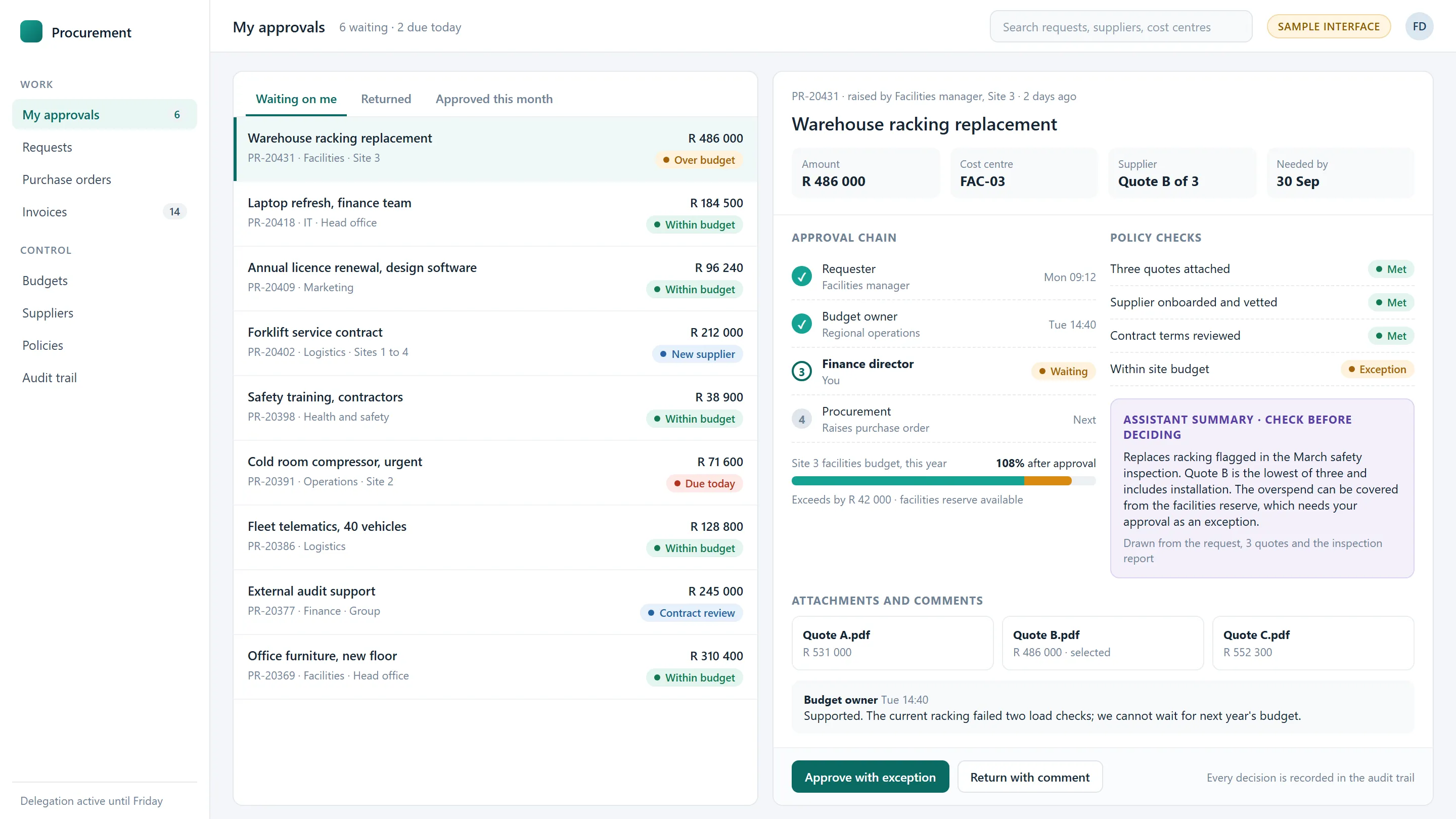
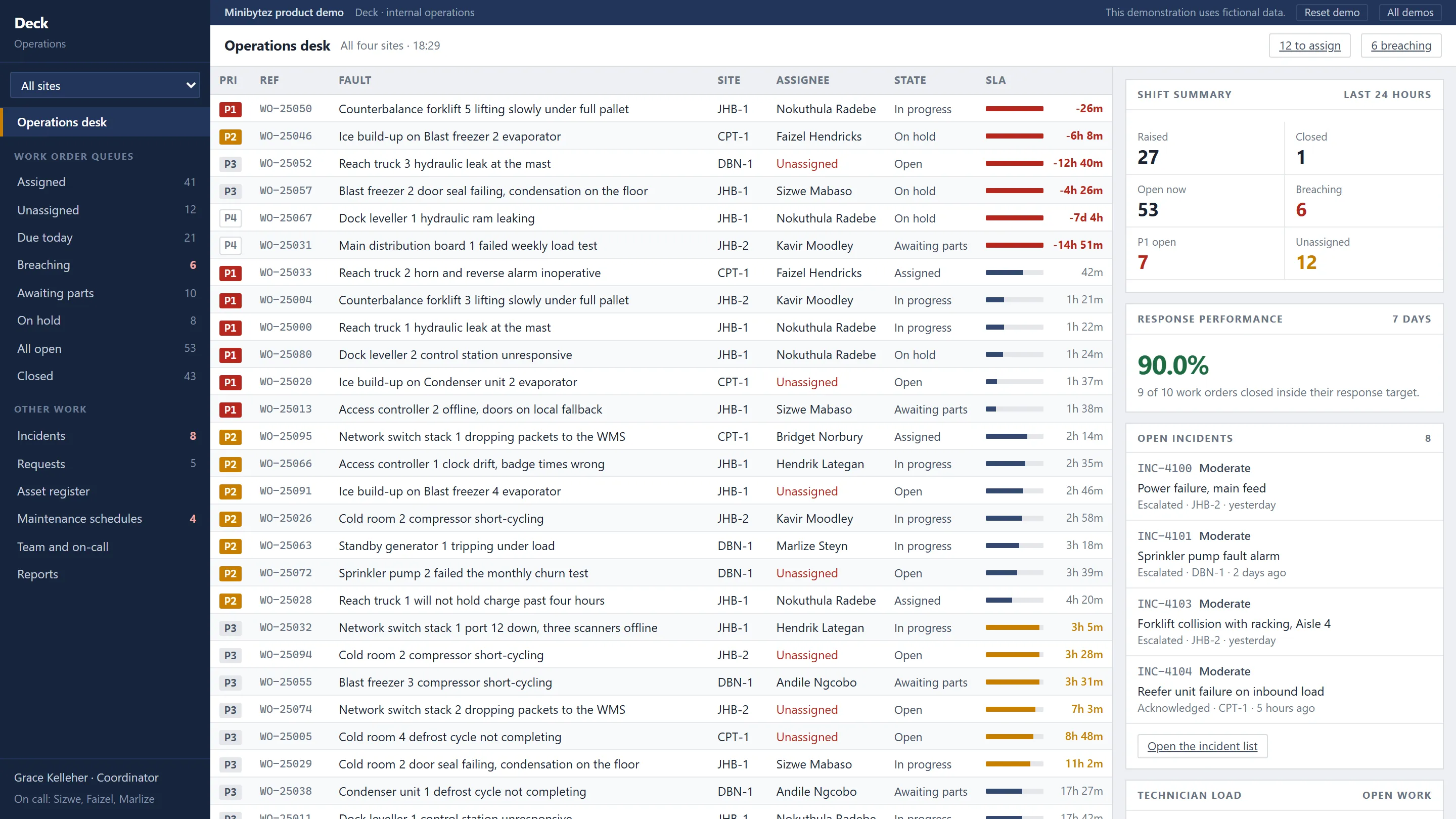
A sample approvals interface, behind Deck, the operations demonstration MiniBytez built.
Not four services. One pipeline.
Getting your existing tools to work together, and taking the repetitive work off your team. Intelligence comes last, once the data underneath it can be trusted.
Your systems
Where the data starts
Accounting, payments, CRM, devices. Most stay exactly where they are.
- Accounting
- Payments
- Devices
Integration
Connected, not replaced
Adapters translate, retry and log every exchange. Where a system has no API, we automate the interface.
- APIs
- Adapters
- RPA
Shared data
One reconciled record
Matching, merge rules and agreed definitions, so every team reads the same figure.
- Reconciliation
- Data platform
- Dashboards
Automation
Work that runs itself
Approvals, reminders, renewals and escalations: scheduled, monitored and logged.
- Workflows
- Documents
- Schedules
Intelligence
Where it earns its place
Summarising histories, classifying requests, drafting replies and forecasting demand.
- AI assistance
- Forecasting
- Classification
Action
A person on what matters
Anything financial, contractual or customer-facing keeps a human checkpoint and a record.
- Approval
- Audit trail
The difference between a build and a programme.
A development team writes software. A programme gets a business through change: scope held, dependencies sequenced, risks owned and every change agreed in writing.
Scope and planning
A written scope, a sequenced plan, and milestones the business recognises.
Dependencies
What waits on what, across teams, vendors and systems that cannot move.
Risks and issues
Named, owned and reviewed, not discovered in the week before go-live.
Change control
Every change to scope, cost or date assessed and agreed in writing.
Stakeholders
The right people informed and deciding at the right points.
Governance
Regular reporting against plan, with decisions recorded where they are made.
Delivered as
- AgileShort cycles where the requirement will move.
- StructuredStage gates where it must not.
- HybridGoverned milestones, agile inside them.
Every pillar, placed on the six steps.
Requirements to support, delivered through the same six steps every engagement follows. This is who leads each one.
See how we buildUnderstand
Requirements and discovery
- Business systems, leads
- Programme delivery, leads
- Engineering, supports
- Enterprise delivery, supports
Design
Architecture and solution design
- Engineering, leads
- Business systems, leads
- Programme delivery, supports
- Enterprise delivery, supports
Build
Engineering and QA
- Engineering, leads
- Enterprise delivery, leads
- Programme delivery, supports
Integrate
Integration and data migration
- Engineering, leads
- Business systems, supports
- Programme delivery, supports
- Enterprise delivery, supports
Launch
UAT, cutover and training
- Programme delivery, leads
- Enterprise delivery, leads
- Engineering, supports
- Business systems, supports
Operate
Support, monitoring and improvement
- Engineering, leads
- Enterprise delivery, leads
- Business systems, supports
Which of these do you actually need?
Usually fewer than people expect, and in a particular order. Describe the problem and we will scope the shortest useful path to solving it.
Clients engage us to
- Fix one system that is holding the business back
- Build a new platform
- Connect the systems you already run
- Automate the manual work
- Deliver a transformation programme
- Operate and improve what is live